
The story of saffron in modern niche perfumery is the story of how a single composition — Maison Francis Kurkdjian’s Baccarat Rouge 540 — turned an obscure traditional perfumery material into one of the most-cited notes of the past decade. Below is the brief history of saffron’s rise in modern niche fragrance, and the affordable compositions that captured the moment.
Saffron before BR540
Saffron has been a perfumery material for centuries, used in traditional Middle Eastern attars and Indian compositions long before Western luxury houses paid attention. The slightly bitter, slightly leathery, slightly warm character that defines saffron in perfume sat largely outside Western commercial perfumery until the early 2010s — appearing occasionally in niche releases but never breaking through as a signature commercial note.
The traditional Middle Eastern use of saffron paired with rose (the foundation of dozens of attars) had been a perfumery direction for centuries. Western houses occasionally borrowed from this tradition (Caron’s earlier work, some Annick Goutal compositions) but the pairing remained outside mainstream Western perfumery.
The 2014 moment: Baccarat Rouge 540
Francis Kurkdjian’s 2014 commission from Baccarat to commemorate the crystal manufacturer’s 250th anniversary produced Baccarat Rouge 540 — a composition built around saffron, jasmine, amberwood, ambergris, fir resin, and cedar. The initial extrait release was limited; the eau de parfum followed as a more accessible bottle.
What made BR540 different wasn’t just the saffron — it was the saffron-amberwood pairing. The saffron sat at the heart, providing distinctive luxury character; the amberwood (a synthetic ambergris molecule) sat in the base, providing glowing projection. Together they produced a signature that became unmistakable: warm, slightly mineral, slightly sweet, distinctly luxurious.
By 2018, BR540 had become the most-cited niche fragrance on YouTube fragrance reviews. By 2020, it had spawned an entire industry of dupes. The signature is now captured affordably by compositions like Maison Francis Kurkdjian Baccarat Rouge 540 dupe, which carries the saffron-amberwood-cedar signature at a small fraction of MFK’s retail price.
The saffron-rose direction emerges
Following BR540’s success, niche brands began exploring different saffron pairings. The most successful direction proved to be saffron-rose — drawing from the traditional Middle Eastern pairing but executed in modern Western polish.
Parfums de Marly’s Oajan (2019) became the most-cited saffron-rose niche release of the late 2010s — captured affordably by Parfums de Marly Oajan dupe. Tom Ford’s Café Rose pursued the polished saffron-rose direction; this is captured by Tom Ford Café Rose dupe.
The saffron-honey direction
Jean Paul Gaultier’s Scandal (2017) pursued a third saffron direction — saffron paired with honey and leather. The original Scandal became commercially successful as a mainstream designer entry; the 2022 Scandal Gold flanker pushed the saffron character harder. Captured affordably by Jean Paul Gaultier Scandal Gold dupe.
The expanding saffron catalogue
By 2023, saffron had become a default note in modern niche perfumery. Compositions like Tom Ford Oud Fleur dupe (spice-led oud with saffron), Tom Ford Cherry Smoke dupe (cherry-smoke with saffron in the heart), and Mancera Instant Crush dupe all feature saffron prominently in the pyramid.
What the saffron moment tells us about modern niche perfumery
The saffron story illustrates how modern niche perfumery actually evolves: a single highly-successful composition (BR540) defines a category, mainstream and affordable-niche brands chase that category, the originating note becomes a default ingredient across the catalogue. The same pattern produced the “modern oud” category after Tom Ford’s 2007 Oud Wood, the “modern leather” category after the same year’s Tuscan Leather, and the “salted vanilla” category after Olympea (2015).
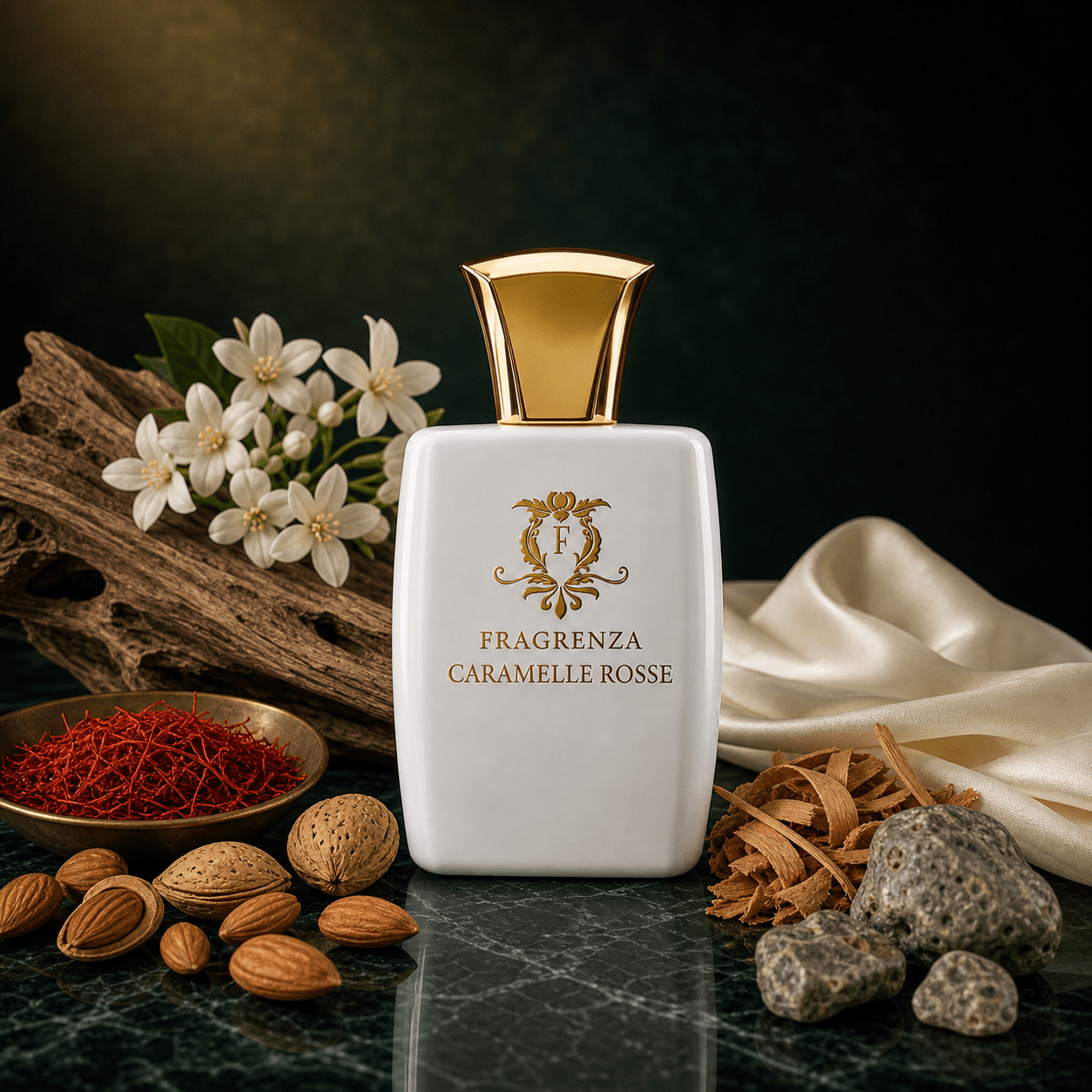
For wearers exploring the saffron category in modern niche perfumery, the entry composition is BR540 (or affordably, Caramelle Rosse). From there, the catalogue opens into Ojen (saffron-rose), Decency Gold (saffron-honey-leather), and dozens of supporting saffron-featuring compositions across both luxury and affordable-niche tiers.
Where saffron is going
The saffron moment in modern niche perfumery shows no sign of slowing — BR540 remains commercially successful a decade after launch, the saffron-rose direction continues to produce successful releases, and new saffron pairings (saffron-cocoa, saffron-incense) appear regularly in niche launches. The note has become permanently established in modern perfumery’s vocabulary in a way that vintage perfumery never achieved.